
Running Injuries & Muscle Soreness
Tips for Avoiding and Treating if It's Too Late to Avoid
Running injuries, if you can avoid them, more running time, if you get one, well now you have some battle scars to prove that your a hardcore runner.
 |
We will start with some tips on how to avoid these little annoyances all together.
Take at least 1-2 Days Off Per Week
Some people can run every day, but most of us can't.
A great way to avoid running injuries is to give yourself one or two rest days between runs. You can simply take off from exercise completely and let your body rest or you can cross train.
Be Sure to Stretch
Stretching is important for any workout, but it is especially important for runners and even more important for runners who are pregnant or nursing. Here are some stretching tips.
Strengthen Those Upper Legs with Weight Training
Strength training for runner is very important in helping avoid running injuries. Upper leg strength training is especially important because making your legs stronger in this area takes some of the pressure off your knees and shins.
And it doesn't have to be hard, you can just fit it in a couple time a week to see amazing results. Here is an article on weight training for runners written just for us running moms.
Running Nutrition
If you have that feeling when you're running like your muscles are really sore and painful, it could be because you're not getting enough nutrition.
My coach always said, "If you wait before you are thirsty to have a drink, you have waited too long." You want to continue drinking throughout your run, but in small amounts so as to avoid stomach cramps or unecessary stops.
A lack of potassium can also cause injuries and muscle cramping. Bananas, a great fuel for runners are very high in potasium.
Here are some of the running nutrients that are very important to keeping you a healthy and injury-free runner.
Warm Up & Cool Down
It is very important to warm up for the first ten minutes or the first mile of your run. You can get an injury if you do too much too fast without giving your muscles a chance to warm up.
It's also important to cool down at the end of your run. You can either run one mile easy to cool down at the end of your run and/or you can follow Tracey's advice which has done wonders for me: at the end of your run, walk one minute for every mile that you ran.
Follow the 10% Rule
You can get injured if you do too much too fast. The rule is to build your running by no more than 10% per week. This counts for both mileage and speed. Once you are more of an experienced runner, you'll get a feel for when and what your body is ready for, but if you're just starting out, or if you're running injury prone, you should make sure to follow this rule.
Running Shoes
You may hear this a lot, but it really can't be said enough. I still forget sometimes that my running shoes can be the biggest culprit when it comes to running injuries.
Just the other day, I posted in a running forum wondering why I was having hip pain. I was really scared about this new running injury that I seemed to be coming down with just when I was starting to really get in a groove.
Then I looked back at my training schedule and how much running I had done with my current shoes, and realized they were pretty old, not to mention how warn out they looked. Sure enough, I got a new pair of running shoes and the pain went away. Wow was that a big relief!
So the lesson: make sure you are running in the right shows for your gait and make sure they are not too old or worn out.
Compression Socks
Compression socks are great at helping to avoid muscle soreness but they can also be worn during your run to help avoid injury. I wear them during my long runs when I feel a shin splint coming on.
Ice or Heat?
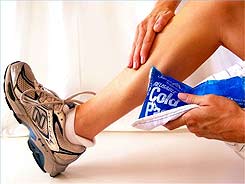
While heat can feel quite soothing on aches and pains, ice is better at treating injuries. Keep an ice pack in the freezer and apply to the sore area any time you feel an injury coming on and this will do wonders in helping you to avoid or stop an injury before it stops you.
Some alternatives to an ice pack are frozen vegetable or washcloth stuffed with ice cubes.
Another option is to try an ice bath after your run. But before you jump in a bath full of ice, be sure to check out these tips. They just might save your butt from freezing off.
Treating Running Injuries
If you get a running injury, it's not the end of the world, even though it sometimes feels like it at the moment. Here are some tips on getting through a running injury.
Here you will find tips on avoiding and treating shin splits and other specific running injuries.
If you are suffering a running injury, check out this interview with my friend Natalie which will give you some support and advice on how to treat and avoid running injuries.
Return from Running Injuries & Muscle Soreness to Running-Mom Homepage